

Lab Highlights
Stay updated with the latest milestones from our research group.
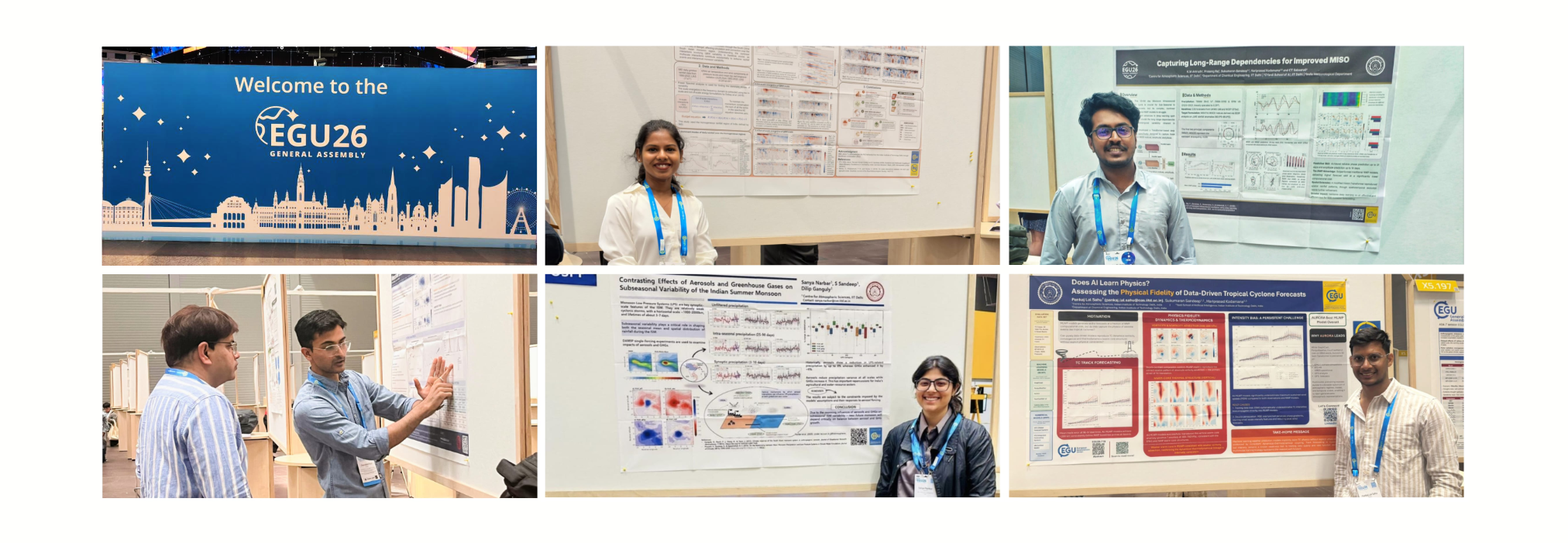
Climate Dynamics Lab at EGU 2026
Research scholars from the Climate Dynamics Lab represented the Centre for Atmospheric Sciences (CAS) at the prestigious EGU General Assembly 2026, held at the Austria Center Vienna in Vienna, Austria. The delegation engaged with global geoscience experts, showcasing the laboratory's latest advancements in tropical monsoon physics and data-driven atmospheric diagnostics.
The participating scholars presented their research abstracts across multiple technical sessions, fostering meaningful scientific dialogues and technical exchanges with international collaborators:
-
Alice Jeeva P. J. — QBW Dynamics and Multiscale Interactions in Contrasting Indian Summer Monsoon Years ↗
Investigating scale interaction processes and the structural dynamics of the Quasi-Biweekly Oscillation (QBW) to advance multi-scale tracking capabilities during contrasting monsoon periods.
-
Sanya Narbar — Contrasting Effects of Aerosols and Greenhouse Gases on Subseasonal Variability of the Indian Summer Monsoon ↗
Evaluating multi-forcing coupled variants to decouple and contrast the internal mechanisms through which atmospheric particulate components alter seasonal precipitation trends under varying global temperatures.
-
Charudatt J. Puri — Barotropic or Baroclinic: The Hybrid Genesis of Indian Summer Monsoon Low-Pressure Systems ↗
Dissecting the fundamental structural origin mechanics of synoptic monsoon depressions to isolate hybrid instability triggers and energy transformations across localized wind fields.
-
Pankaj Lal Sahu — Does AI Learn Physics? Assessing the Physical Fidelity of Data-Driven Tropical Cyclone Forecasts ↗
Probing data-driven weather prediction architectures with strict testing controls to evaluate whether deep neural layers faithfully preserve underlying fluid dynamic conservation rules during severe tropical cyclone simulations.
-
Anirudh K. M. — Capturing Long-Range Dependencies for Improved MISO Prediction via Deep Learning ↗
Engineering specialized deep neural learning pipelines capable of capturing long-range atmospheric dependencies to upgrade predictive baseline skills across complex sub-seasonal forecast scales.

Prof. Sandeep appointed Mittal Foundation Chair in Climate Sciences
We are delighted to share that Prof. Sandeep Sukumaran has been appointed as the Mittal Foundation Chair Professor in Climate Sciences at IIT Delhi. The appointment is for a distinguished period of three years, beginning July 2025.
This recognition by the IIT Delhi Board of Governors highlights his exceptional contributions to advancing tropical climate dynamics and monsoon research bounds. The Chair framework will support further computational acceleration and innovation in operational monsoon forecasting models and climate science initiatives at the laboratory.

AI Transforming Meteorological Prediction Through Innovation
Our recent milestone research focusing on severe tropical cyclones and Monsoon Intraseasonal Oscillations (MISO), engineered under the joint guidance of Professors Sandeep Sukumaran and Hariprasad Kodamana, has garnered widespread national attention. The dual studies have been published in the high-impact Journal of Geophysical Research: Machine Learning and Computation and heavily featured across prominent national mainstream media streams.
-
The Times of India — IIT-Delhi AI model forecasts monsoon 18 days in advance ↗
Our deep model tracks spatial monsoon variables 18 days ahead and maps tropical cyclone trajectories down within a 200km scale up to four days early.
-
Business Standard — AI transforming meteorological prediction ↗
Detailing how transformer neural networks trained across 25 years of multi-source spaceborne observations decode complex monsoon physics natively.
-
The Week (PTI) — IIT AI model improves weather accuracy ↗
Demonstrating actionable data pipelines where deep neural layers augment traditional numerical fluid mechanics to reduce forecasting errors.
-
ABP News — अब 18 दिन पहले ही पता चल जाएगा मॉनसून का मूड ↗
IIT दिल्ली के वैज्ञानिकों ने नया AI मॉडल तैयार किया है, जो मॉनसून का पूर्वानुमान 18 दिन पहले ही दे सकता है—यह मौजूदा तकनीकों से अधिक तेज़ और प्रभावी है।
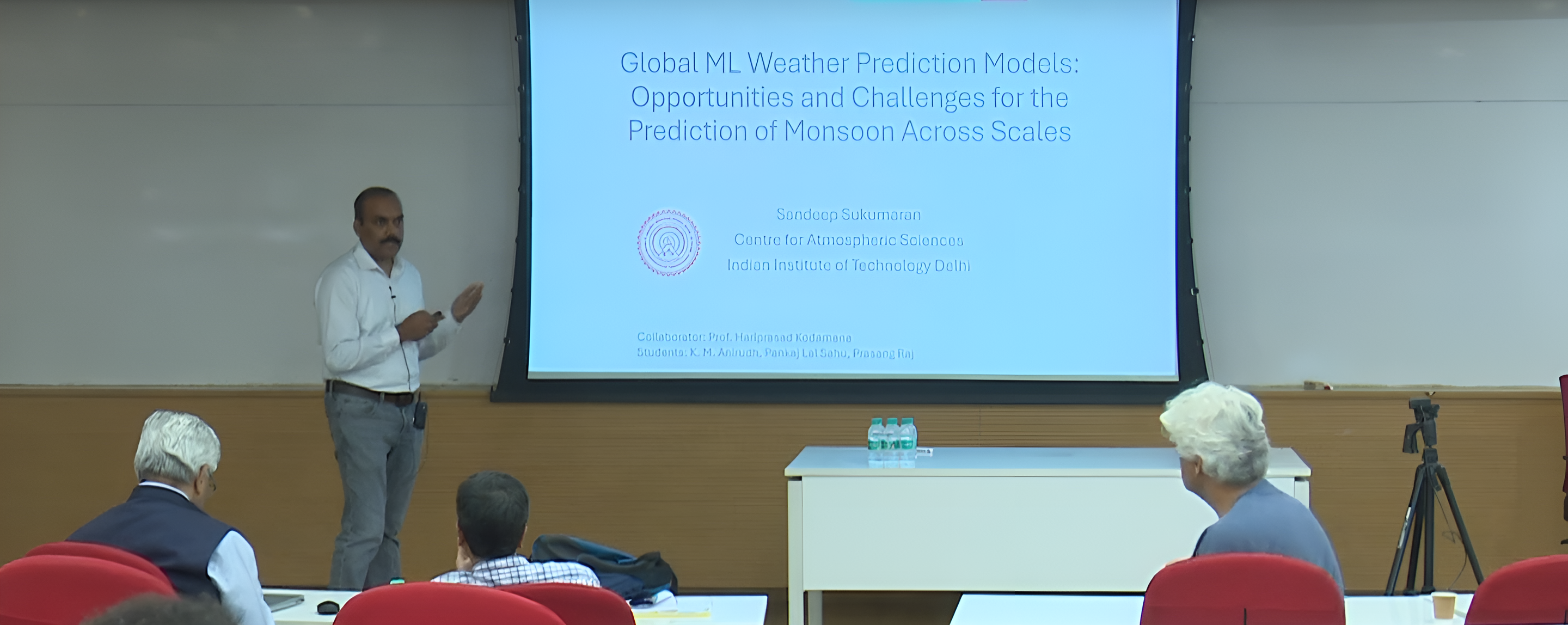
Global ML Weather Models for Monsoon Forecasting
Prof. Sandeep Sukumaran unpacks technical opportunities, constraints, and predictability parameters encountered when deploying global ML weather models for long-range monsoon tracking at SCDLDS, Ashoka University.